This post includes a brief plot explanation, an analysis, and a review of the 2004 film “The Stepford Wives”. Beware of spoilers.
Note: From time to time, I like to revisit films that I have enjoyed in the past and see how I feel about them today. “The Stepford Wives”, in my opinion, turned out to be a very pleasant surprise. Back in the day, I found the film funny, but rewatching it as an adult, I find it hilarious.
Having said that, I’ve decided to share my honest thoughts regarding this film, which many seem to hate.
What if your spouse could be programmed to meet your every desire? In the 2004 remake of “The Stepford Wives”, director Frank Oz peels back the layers of suburban perfection to uncover a disturbing truth. This dark comedy based on Ira Levin’s novel with a modern twist features an all-star cast including Nicole Kidman, Matthew Broderick, Glenn Close, and Christopher Walken.
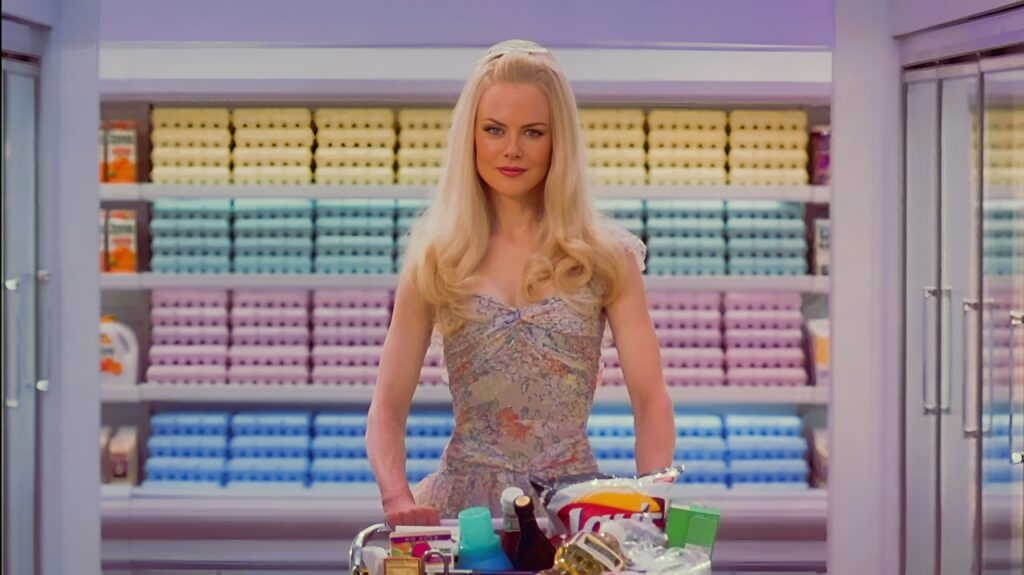
Short Review: “The Stepford Wives” is a good watch. It’s self-indulgent in a positive way, as it doesn’t try to pretend to be something that it is not. The film embraces clichés and tropes without any shame. Also, “The Stepford Wives” is happy about not taking itself too seriously. Although Nicole Kidman is not naturally gifted in comedy, she does do a competent job.
“The Stepford Wives” is about a TV executive who moves to an idyllic suburb after suffering a nervous breakdown.
Joanna Eberhart is the protagonist of this story. She is the breadwinner, calling all the shots at her work and in her home. However, a terrible incident at her workplace gets her fired.
Although Joanna gracefully leaves her job, she is livid, filled with anger and frustration. Walter, her husband, hates to see her down. Therefore, he suggests a change of environment for the family. New place, new beginnings, right? The Eberharts move into a seemingly perfect town called “Stepford”.
Nevertheless, there is something sinister about the place and the people. Joanna is not the only one who notices this; her new friends, Bobbie Markowitz and Roger Bannister, share the same suspicions. By the way, just like Joanna, they are highly successful people.
Then, one by one, each of Joanna’s friends turns into “perfect spouses”. And Joanna is going to be next… So what is going on in this bloody town? They are all part of a bigger plan by a very twisted mind called Claire Wellington.
Many years ago, Claire found her husband, Mike, cheating on her with a much younger, blonder woman. Out of rage, she killed them right on the spot. To fill the void, Claire built her own perfect husband, Mike. And together they built “Stepford”. However, people don’t just stumble to this place.
As mentioned before, everyone before becoming a “Stepford spouse” was someone in the outside world. And the husbands were not happy about it, so they lured their partners to Stepford under the premise of getting more quality of life. When in reality, they wanted to brainwash their spouses into becoming more subservient.
Nonetheless, there is still some hope in the world. Walter never turned Joanna into a “Stepford wife”; she was just pretending. Together, the couple manages to deactivate the chip that is making the women “obedient”. Havoc breaks when the women “wake up”. Mike and Walter get into a fight, and Joanna “decapitates” Mike.
A distraught Claire kisses Mike’s head; she dies from the electrocution. The film ends with Joanna and Bobbie profiting from their “traumatic experience” and the husbands under house arrest for what they did.
The film is essentially a satire on traditional gender roles, suburban life, and the pressures of modern society.
“The Stepford Wives” is a film that touches upon societal issues without taking itself too seriously. For instance, most of the male characters are very “weak”. It goes beyond misogyny; instead of appreciating and supporting their highly successful spouses, they chose the easy route.
In the film, men don’t want to become better. They want to drag their spouse down so they can feel above them. “Lazy” would be the word that I’m looking for to describe these men. Although “The Stepford Wives” is just a film that makes fun of this particular stereotype of men, they are out there… somewhere.
Then Stepford itself is an exaggerated picture of the American dream. Everyone desires perfection, in the form of perfect lawns, cookie-cutter houses, and ideal spouses. But at what cost? Conformity often comes with a certain loss of identity, so is it really worth it?
Last but not least, “The Stepford Wives” also invites a discussion about the challenges of modern society for men and women. Let’s take Joanna Eberhart as an example. Whenever someone chooses to invest heavily in their work, usually their personal life suffers. In today’s world, women are sold a big lie: “You can have it all.” That’s unfortunately not true.
On the other side of the coin, there are people like Walter, the partners of successful women. What can they do to keep up? Do they need to do better? Or can they just be themselves? That is the real question. What is the role of men like Walter when they have a woman like Joanna?
While I admit that we still have a long way to go regarding women’s rights, I can emphasize with men’s struggles to adapt to such drastic changes in our society’s structure.
What I particularly liked about “The Stepford Wives” was its shameless exploitation of stereotypes.
Every character in the film is the embodiment of a certain stereotype. For instance, Joanna is the career-driven woman, dominant and unfeminine. Then, there is Bobbie, a man-hater disguised as a feminist. Let’s not forget about Roger, the flamboyant gay who is then forced to conform to gender norms when he is transformed into a hyper-masculine version of himself.
Except for Walter, every other man in Stepford is some sort of sexist scum who desires submissive wives who are willing to cater to their needs.
Everything that I said sounds negative, but actually it is not, because it works in a film like “The Stepford Wives”. People often equate stereotypes with uni-dimensional characters, but when used the right way, they can be quite hilarious. Personally, I loved the exaggerated performances.
While the original 1975 film was a straight-up horror, the 2004 version takes a comedic approach to address its themes.
Actually, I like the comedic approach to Ira Levin’s novel. The whole concept of the Stepford world is quite terrifying when one tries to think about it. It’s a patriarchal society taken to an extreme. How dreadful would it be to translate that into reality?
That said, I believe the modern twist with a humorous tone made the story easier to digest. It’s not about being simple-minded but using heaviness in the right places. If not done correctly, an over-serious tone can sometimes come off as pretentious.
The ending of “The Stepford Wives”, revealing Claire Wellington as the mastermind, adds an interesting twist to the film’s plot.
Presenting a woman as the architect of this patriarchal society subverts the expectation of male-driven oppression by men.
The unexpected twist invites the audience to challenge their thoughts on gender roles. It suggests that misogyny and pressure to conform to societal expectations come mainly from outside, but over time, it can also be something internalized (that comes from within).
Final Thoughts
The performances in “The Stepford Wives” were delightful. Nicole Kidman was great as the neurotic, career-driven woman. Bette Midler was a joy to watch as the messy, recovering alcoholic writer, and Roger Bart was hilarious as the flamboyant architect turned wannabe senator.
I have only one qualm with the film, which is the tech part. It’s never explained how Joanna was able to look like a “Stepford wife” without actually becoming one. My assumption was that all the original wives were “disposed” and their brains or consciences were somehow implanted into their new robot bodies.
Overall, “The Stepford Wives” is not perfect, but it’s entertaining and a noteworthy watch. The film’s strength lies in not taking itself too seriously. I guess those who hate it didn’t get the joke.
Final Rating: 🍎 (Good)