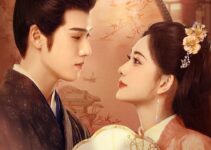
This post includes a brief summary, analysis, and review of the 2026 Chinese drama “Glory”. Beware of mild spoilers.
Note: There are too many dramas with the word “Glory” in them. There is a k-drama named “The Glory” (2022), and then there is a c-drama named “The Glory” (2025) starring Chen Duling. Today’s review is on “Glory” (Yù míng chá gǔ), the 2026 Chinese drama starring Gulinazha and Hou Minghao.
Guo Hao, Zhang Zhi Wei, and Ma Shi Ge are the directors of the 2026 period drama “Glory”.
Genre: Historical, Drama, Romance

Short Review: “Glory” is an exciting drama to watch. It’s gorgeous, and it has an epic quality to it. What sets the drama apart from others is its unconventional protagonist. Rong Shan Bao is fierce and unapologetic, a stark contrast to the commonly docile and submissive female lead character often found in Chinese dramas. The leading actress, Gulinazha, did a phenomenal job and absolutely shines as “Rong Shan Bao”.
“Glory” tells the story of a businesswoman who saves a magistrate, who later becomes her servant.
The protagonist of “Glory” is Rong Shan Bao; she is the future heiress of a huge tea empire. The Rong family runs at a different pace than others.
First of all, the Rongs are extremely rich; not only that, but they are also extremely well connected. In other words, they are powerful enough to influence local government officials. Second, the Rongs are a matriarchal family. The “head honcho” is an old woman who is calling all the shots. Even Rong Shan Bao, who is the future heiress, has to bow to her.
On the other side of this story, there is Lu Jinglai, a young magistrate named by the emperor to investigate the murder of a married woman, Madame Yang. That case is somehow connected with the Rong family. The problem is he cannot even enter their mansion; the Rongs are purposely giving the magistrate the cold shoulder.
Before Lu Jianglai could pursue the investigation further, he was ambushed. On the brink of death, he meets Rong Shan Bao, who rescues him. An amnesiac Lu Jianglai becomes the servant of the Rong family. Rong Shan Bao is keeping him in the mansion because he is useful to her.
During his time at the Rongs’ mansion, Lu Jianglai learns that he has stepped into a complex den of secrets, rivalries, and unspoken rules.
As his memories slowly return, Lu Jianglai also becomes increasingly infatuated with Rong Shan Bao. The feelings seem to be mutual. Although they are attracted to each other, there is a lot of suspicion, deceit, and manipulation that also pulls them apart. As the story unravels, the two work together to overcome each other’s personal obstacles…
The Rong family, tea, and power
The tea empire explains why the Rongs are so powerful. They don’t simply sell tea; they control who gets work and who gets the chance to move up in life. In addition, the Rongs also have a saying on who can stay or enter in the tea business.
There is a reason why the Rongs have so many personal guards. The tea business is not “cute”; actually, it can be pretty ruthless. Our protagonist almost died while trying to save the tea shipment from bandits.
However, it is also that same power that draws so many people to the Rong family. Everybody covets their money and power. That’s why men were so desperate to become Rong Shan Bao’s husband.
“Glory” is about female agency, and it goes beyond one “strong heroine”.
What I liked about the show is that female agency is not only about Rong Shan Bao and her personal agenda. There are other strong female characters in the drama, and I absolutely love it. On one hand, I love seeing Rong Shan Bao being ambitious, arrogant, and assertive. But on the other hand, I also enjoy other female characters fighting for their own destiny in their own way.
Another aspect that I really appreciate about “Glory” is that it doesn’t try to create a fictitious world where women have power. Instead, it shows women navigating fiercely in an oppressive patriarchal society. It’s a very refreshing approach, in my opinion.
Note: “Glory” does not empower its female characters by making them act like men. Instead, it shows women making strategic decisions to get what they want. The show does not only focus on strengths but also common struggles that women had to go through during those times.
Lu Jianglai and Rong Shan Bao are not your typical idol couple.
The relationship between Lu Jianglai and Rong Shan Bao is where “Glory” really sets itself apart from standard idol dramas. Forget about cute and fluffy romance; there is none of that here. Instead, there is tension, power dynamics, and deception. And I love every bit of it.
Having said that, the chemistry between Gulinazha and Hou Minghao hits very differently from your usual sweet idol pairing. Finally, we get to see two adults who are attracted to each other but might not end up together. Some viewers complained about the ending because it’s not your typical “happily after”. Personally, I found it very adequate for our leads.
Gulinazha gave a wonderful performance as Rong Shan Bao.
As a newbie in the Chinese dramaland scene, I heard that Gulinazha’s acting skills were… unreliable. You know, some actors are more known for their visuals than their acting per se. So, I was a bit hesitant about watching “Glory”, but I’m glad I did.
I don’t know what Gulinazha did in the past to deserve such remarks… However, even if those were true, she totally redeemed herself in “Glory”. Here, I felt she was the perfect casting choice for Rong Shan Bao.
The protagonist is both elegant and intimidating, and I believe Gulinazha was able to perfectly embody those qualities. I loved her micro-expressions, and it’s incredible how beautiful she can look in one second and scary in the other.
Gulinazha’s chemistry with Hou Minghao felt surprisingly natural. Trust me, there is nothing more awkward to watch than two actors trying to sell the idea that they are attracted to each other. It’s so lame and sad whenever that happens.
Final thoughts
Overall, “Glory” is a must-watch, but it comes with a small caveat. If you’re looking for a clean and cute story where good people and bad people can be easily labelled, then this drama might not be for you.
Many of the show’s characters, especially the leads, are morally ambiguous people. They lie, manipulate, and deceive whenever it’s convenient for them. And the show doesn’t always punish them for it. However, for someone like me, the moral grayness is the key element that “spices up” the show.
On top of the writing and performances, the cinematography and soundtrack elevate everything. The visuals and music were the cherry on top of the cake that added a touch of grandeur that the show needed to be epic. Otherwise, it would have felt just like a boring soap opera.
Final Rating: 🍎🍎 (Very Good)